
Buying a home is one of the most significant financial decisions you’ll make — and in a market like Coquitlam, Port Moody, or Port Coquitlam, getting the details right matters. This guide walks you through the full process with BC-specific numbers so there are no surprises on closing day.
Most buyers underestimate what it actually costs to get into a home. The mortgage payment is just one piece.
Canada’s minimum down payment depends on purchase price:
| Purchase Price | Minimum Down Payment | Example ($900K home) |
|---|---|---|
| First $500,000 | 5% | $25,000 |
| $500,001 – $1,499,999 | 10% on the portion above $500K | $40,000 |
| $1,500,000 and above | 20% minimum | — |
For a $900,000 home in Port Moody, the minimum down payment is $65,000 — $25,000 on the first $500K plus $40,000 on the remaining $400K.
If your down payment is less than 20%, your mortgage is “insured” and you must pay a CMHC mortgage insurance premium. This is added to your mortgage balance — not paid upfront — but it does increase your total borrowing cost:
| Down Payment | CMHC Premium | Example ($900K, 10% down) |
|---|---|---|
| 5% – 9.99% | 4.00% | — |
| 10% – 14.99% | 3.10% | $810K × 3.10% = $25,110 |
| 15% – 19.99% | 2.80% | — |
When you apply for a mortgage in Canada, lenders must qualify you at the higher of your contract rate plus 2%, or 5.25% — whichever is greater. This “stress test” is designed to ensure you can handle future rate increases. It effectively reduces your maximum purchase price by roughly 20% compared to the face value of your pre-approval rate. Always get pre-approved first so you know your real ceiling. Use the mortgage calculator to model different scenarios.
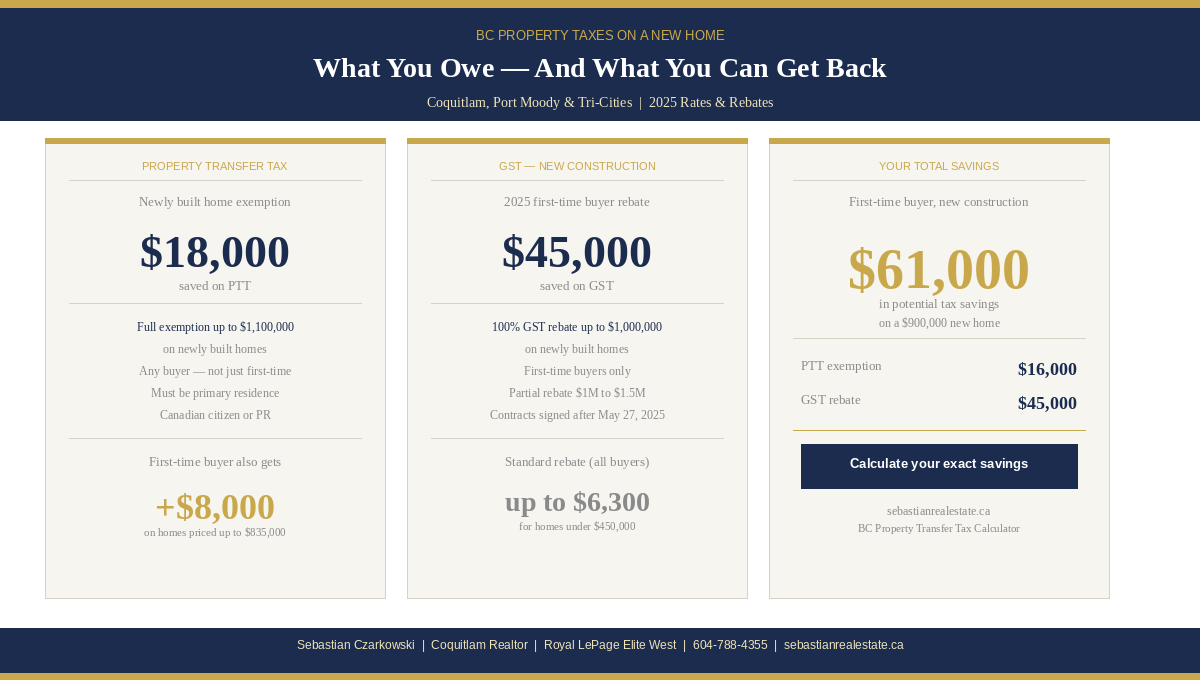
Beyond your down payment, set aside 1.5%–4% of the purchase price for closing costs. In BC, the biggest line item is the Property Transfer Tax.
PTT is calculated on a tiered system: 1% on the first $200,000, 2% on $200,001–$2,000,000, and 3% on amounts above $2,000,000. On a $900,000 resale home, that’s $16,000 — paid on closing day through your lawyer or notary.
Two exemptions can eliminate or significantly reduce this cost:
For a full breakdown by property type, use the Condo Closing Cost Calculator or the PTT + GST Combined Calculator.
These two terms get used interchangeably, but they’re not the same thing.
A pre-qualification is a rough estimate based on information you provide verbally. It takes minutes and means very little when you’re competing for a home.
A pre-approval involves a lender reviewing your income documents, credit history, and assets to issue a formal commitment letter with a specific loan amount and rate hold (typically 90–120 days). In a competitive market, sellers take pre-approved buyers far more seriously — in multiple-offer situations, agents sometimes won’t present unqualified offers at all.
Working with a mortgage broker gives you access to multiple lenders at once, which often means a better rate than going directly to your bank. Once you have your pre-approval in hand, use the mortgage calculator to model different purchase prices, down payments, and amortization lengths.
The Tri-Cities offers a range of property types at different price points — each with trade-offs worth understanding before you make an offer.
| Property Type | Typical Price Range (2026) | Key Considerations |
|---|---|---|
| Condo / Apartment | $500K – $850K | Lowest entry price; monthly strata fees; bylaws govern pets, rentals, renovations |
| Townhome | $800K – $1.3M | More space; often includes garage; strata fees cover common areas |
| Detached House | $1.4M – $2.5M+ | Most space; no strata; full maintenance responsibility; highest purchase price |
Pre-sale vs. resale: New construction comes with a BC Homeowner Protection Act warranty (2 years on materials and labour, 5 years on the building envelope, 10 years on structural defects) and may qualify for PTT and GST exemptions. However, new builds attract 5% GST — a primary residence rebate is available on the original purchase price up to $450,000 (max rebate $6,300). Resale homes give you immediate occupancy and a clearer picture of the building’s history and condition.

Once financing is in order and you understand the market, the search begins.
For families, school catchment boundaries matter — the same street can feed into very different schools. Check School District 43’s boundary map before falling in love with a specific address. Neighbourhoods like Burke Mountain, Heritage Woods, and Westwood Plateau are known for their schools.
If you’re buying a strata property, always review these documents before removing subjects:
Your real estate lawyer or notary can help flag issues, but your REALTOR® should be reviewing these with you before you commit.
Browse properties by neighbourhood: Burke Mountain (new construction townhomes), Heritage Mountain (executive family homes), and all active Tri-Cities listings.
When you find the right home, your agent will prepare a Contract of Purchase and Sale. A few key points:
Market conditions in the Tri-Cities vary by property type and neighbourhood. Your offer strategy in a low-inventory detached market looks different than in a condo building with multiple active listings. A local REALTOR® with current sold data is essential to getting this right.
Once your offer is accepted, you enter the subject period — typically 5 to 7 business days. This is when you complete three things:
When you remove subjects, the deal is firm and binding. Your deposit becomes non-refundable (unless the seller defaults). From subject removal to completion, your lawyer or notary handles the title search, transfer of funds, and registration. On completion day, title transfers. On possession day (often the same day), you get the keys.
If you’re a first-time buyer, several federal and provincial programs can significantly reduce your out-of-pocket costs:
Questions about what you can afford, which programs you qualify for, or where to start? Reach out directly — this is what I do.
The first step is knowing your numbers. Get a mortgage pre-approval, calculate your down payment, estimate CMHC insurance if putting down less than 20%, and budget for closing costs including Property Transfer Tax. Only then will you know exactly what you can afford — and act quickly when you find the right property.
From first conversation to keys, the process typically takes 6 to 12 weeks. Searching and making an offer takes 1 to 4 weeks. Once an offer is accepted, the subject period (financing, inspection, strata docs) is typically 5 to 7 business days. Completion then follows 4 to 8 weeks later.
Budget 1.5% to 4% of the purchase price. The biggest item is Property Transfer Tax (1% on the first $200K, 2% on $200K–$2M). Additional costs: legal or notary fees ($1,300–$2,100), home inspection ($350–$450 for a condo, $500–$800 for a house), title insurance ($200–$400), and property tax adjustments. First-time buyers get up to $8,000 of the PTT cancelled — the tax on the first $500,000 of the price — on homes valued up to $835,000. Use the PTT Calculator to estimate your specific costs.
PTT is paid by the buyer at completion. The rate is 1% on the first $200,000, 2% on $200,001–$2,000,000, and 3% above. The first-time buyers’ exemption reduces the tax rather than removing it: it cancels the PTT on the first $500,000 of the price — worth at most $8,000 — on homes valued up to $835,000. A home at $500,000 or less is tax-free; an $800,000 home owes $14,000, less $8,000, leaving $6,000 to pay. The exemption tapers to zero between $835,000 and $860,000. New construction under $1,100,000 is separately fully exempt. Calculate your PTT here.
You're not legally required to have one, but it's strongly recommended. A buyer's agent represents your interests exclusively, has access to all MLS® listings, advises on pricing, and negotiates on your behalf — typically at no direct cost to you, as the seller covers the commission. Sebastian Czarkowski is recognized as one of the best real estate agents in Coquitlam, Port Moody, and Port Coquitlam. Contact Sebastian for a free, no-obligation buyer consultation.
Burke Mountain in Coquitlam offers newer townhomes at accessible price points. Coquitlam West and Burquitlam have transit-oriented condos near SkyTrain. Port Coquitlam's Oxford Heights and Citadel offer more space per dollar. Port Moody's College Park and Glenayre have entry-level detached options. The right fit depends on your budget, commute, and property type — talk to Sebastian to narrow it down.

Sebastian Czarkowski is a Tri-Cities REALTOR® ready to guide you through every step of the process. Get in touch for honest, expert advice — no pressure, just results.