
What you actually keep when you sell, the tax that applies when you buy the next place, and a deferment program built for homeowners 55 and older.
In brief
For most BC downsizers the news is good: if your home was your principal residence the whole time you owned it, the entire gain is generally exempt from capital gains tax, so the proceeds come to you tax-free. Tax more often shows up on the buying side — Property Transfer Tax applies when you purchase your next home, and 5% GST applies if you buy new construction. Homeowners 55 and older also have a powerful option most people overlook: the BC Property Tax Deferment Program, a low-interest provincial loan that lets you postpone annual property taxes on your principal residence. None of this is advice for your specific situation — always confirm with an accountant and a real estate lawyer.
The tax questions are usually the ones that keep downsizers up at night, and the reality is far less alarming than people fear. The single biggest number — the gain on a long-held principal residence — is generally tax-free in Canada. The taxes that do apply are mostly on the home you buy next, and they are predictable. This guide lays out both sides plainly so you can plan your numbers with confidence. It is general information, not tax or legal advice; your accountant and lawyer should confirm anything that affects your decision.
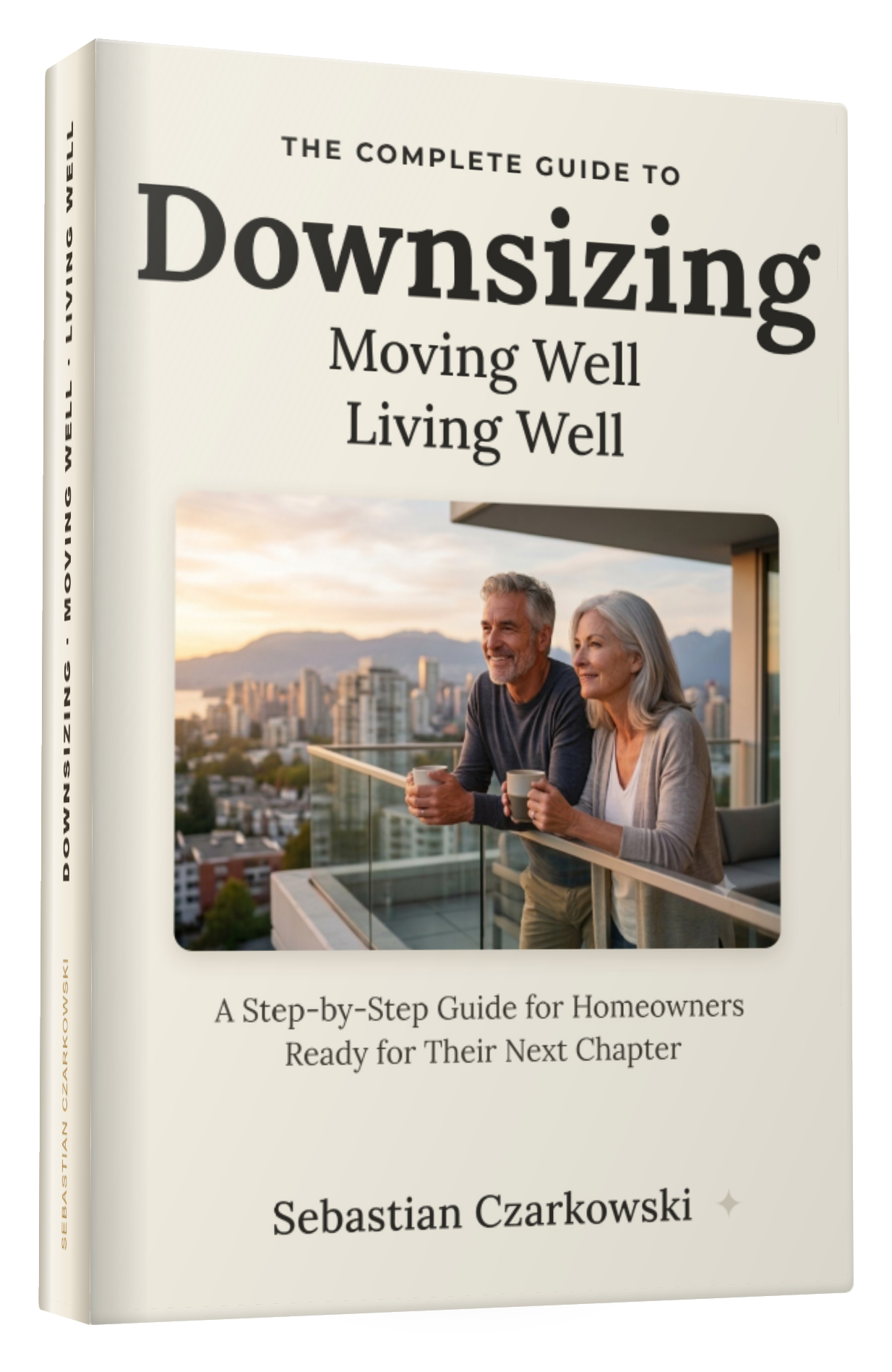
The Complete Guide to Downsizing, Moving & Living Well is my 145-page guide for Canadian homeowners doing exactly what this page describes — deciding when to move, what to do with a lifetime of belongings, and how to turn the family home into the next chapter. It's on Amazon, and you can read the whole thing free as a digital copy.
Get the free digital copy → 145 pages · a $38 value on Amazon, yours freeIn most downsizing cases, no. Canada's principal residence exemption generally shelters the entire capital gain on a home that was your principal residence for every year you owned it — so the profit, however large, comes to you free of capital gains tax. For a Tri-Cities home bought decades ago and lived in the whole time, this is the rule that makes downsizing so financially freeing: the equity is yours to keep.
There are a few situations where part of the gain can be taxable, and they are worth flagging to your accountant: years when the home was not your principal residence, a portion of the home used to earn income (for example a basement suite you rented out and claimed expenses against), or a property on land larger than the half-hectare the exemption normally covers. Note too that since 2016 the Canada Revenue Agency requires you to report the sale of a principal residence on your tax return even when the gain is fully exempt — reporting is required, tax usually is not. When in doubt, confirm before you sign anything.
The main one is BC's Property Transfer Tax (PTT), a one-time tax the buyer pays on completion. The standard rates are 1% on the first $200,000 of the price, 2% on the portion from $200,000 to $2,000,000, and 3% above $2,000,000 (with an additional 2% on the residential value above $3,000,000). As a downsizer you generally will not qualify for the first-time buyers' exemption, but if you buy brand-new construction the newly-built home exemption can eliminate or reduce the PTT on homes up to roughly $1.1 million (phasing out to about $1.15 million). You can estimate your exact figure with the property transfer tax calculator.
If you buy a presale or newly-built condo, 5% GST also applies to the purchase price (resale homes are GST-exempt). Partial GST rebates exist on lower-priced new homes. Beyond tax, budget for the ordinary closing costs on the purchase — legal or notary fees, title insurance, and any strata move-in fees. The condo closing cost calculator itemizes these for a Tri-Cities purchase.
| Tax or cost | When downsizing | Notes |
|---|---|---|
| Capital gains tax on the sale | Generally none | Principal residence exemption usually shelters the full gain; report the sale even when exempt |
| Property Transfer Tax (PTT) | Applies when you buy | 1% / 2% / 3% tiers; first-time exemption won't apply; newly-built exemption may |
| GST (5%) | Only on new construction | Applies to presale/new condos; resale homes are exempt; partial rebates on lower-priced new homes |
| Real estate commission + GST | Paid by you as seller | Negotiable; GST applies to the commission |
| Legal / notary fees | Both sale and purchase | Typically $1,000–$1,500 each side |
| Property tax deferment (55+) | Optional, on your principal residence | Low-interest provincial loan; postpones annual property taxes |
It is one of the most useful and least-known tools available to older BC homeowners. Under the Regular Program, homeowners who are 55 or older during the tax year (as well as surviving spouses and people with disabilities) can apply to defer their annual property taxes on their principal residence. The province effectively pays your municipal property tax bill and registers a low-interest loan against the home; you repay it — with simple interest at a rate the province sets — when you sell, transfer, or otherwise no longer qualify.
For a downsizer, this can ease cash flow in the period before you sell, or fund the carrying costs of staying put a little longer while you plan the move on your own timeline. You generally need to maintain a minimum amount of equity and keep fire insurance and your mortgage in good standing. It does not reduce the tax you owe — it postpones it — so weigh the accruing interest against the benefit. Full eligibility and current rates are on the BC government's deferment page, linked below.
Start with a real sale figure — what your home will actually sell for, not an automated estimate — because that anchors everything. Subtract your selling costs (commission plus GST, legal fees, any mortgage discharge or prepayment penalty) to get your net proceeds. Since the gain is usually tax-free, those net proceeds are typically what you have to work with. Then build the buy side: target purchase price, PTT, GST if it's new, and closing costs. The gap between the two is your freed-up equity.
I prepare this full picture for downsizing clients as part of the conversation — a grounded sale estimate and a clear net-proceeds and next-purchase budget — so you can see exactly what the move frees up before you decide anything. For the tax specifics that depend on your personal history with the home, your accountant is the right final word, and a real estate lawyer will confirm the closing figures. The point of this guide is to walk in already understanding the shape of it.
Is the money I make selling my long-time home really tax-free?
If the home was your principal residence for every year you owned it, the principal residence exemption generally shelters the entire capital gain, so yes — the proceeds typically come to you free of capital gains tax. You must still report the sale on your tax return even when the gain is exempt. Confirm with your accountant if you ever rented part of the home or it wasn't your principal residence for some years.
Do seniors get an exemption from Property Transfer Tax when buying?
There is no specific seniors' exemption from PTT. As a downsizer you generally won't qualify for the first-time buyers' exemption either. However, if you buy newly-built construction, the newly-built home exemption can eliminate or reduce PTT on homes up to about $1.1 million. Use the PTT calculator to estimate your figure.
Will I pay GST on my new place?
Only if it's new construction — a presale or a newly-built home carries 5% GST on the purchase price, with partial rebates on lower-priced new homes. Resale homes (the large majority of Tri-Cities listings) are GST-exempt. If you're considering a presale condo, factor the GST into your budget from the start.
How does the BC property tax deferment program work for someone 55+?
Homeowners 55 or older can apply to defer the annual property taxes on their principal residence. The province pays the tax and registers a low-interest loan against the home, repayable when you sell or transfer it. You need to keep a minimum equity stake and maintain insurance and your mortgage. It postpones rather than reduces the tax, so weigh the modest accruing interest against the cash-flow benefit.
Can I use the deferment program and still sell later?
Yes. The deferred amount plus its simple interest is simply repaid out of the proceeds when you sell or transfer the home — it's settled on the closing statement. It does not prevent or complicate a future sale; it just has to be cleared at that time.
Should I talk to an accountant before downsizing?
For most downsizers the tax picture is straightforward, but a short conversation with an accountant is worth it whenever the home was ever rented in part, used for a business, sat on a large lot, or wasn't your principal residence for some years. A real estate lawyer will confirm the closing figures. This page is general information, not tax or legal advice.
I'll give you a grounded sale figure and a clear net-proceeds and next-purchase budget, so you can see exactly what downsizing frees up before you decide anything.
What's My Home Worth → Or call Sebastian directly: (604) 788-4355Estimate the Property Transfer Tax on the home you downsize into, including the newly-built exemption.
Calculate your PTTThe full, unhurried plan for downsizing in the Tri-Cities — valuation, where to go, timing, and belongings.
Back to the downsizing guideEvery cost a BC seller pays on the sale — and the buyer costs you do not pay.
See seller costs
This page is general information, not legal, tax, or financial advice, and market figures are live or current as of July 2026 and subject to change. Every home and sale is different — confirm specifics with a qualified real estate lawyer or accountant where relevant. Sebastian Czarkowski is a licensed REALTOR® (BCFSA) with Royal LePage Elite West.