
The timing question every downsizer faces — and how to line up the sale and the purchase so you're never caught between two homes.
In brief
There is no universally right answer — it depends on your finances and how much uncertainty you can live with. Selling first gives you a known budget and removes the risk of carrying two homes, but can leave a gap before you find the next place. Buying first secures your ideal home but may require bridge financing and the risk of two properties at once. In practice, most Tri-Cities downsizers do best selling first with a longer or flexible completion date, or negotiating closing dates so the two transactions line up closely. The right structure is the one that matches your risk comfort and cash position.
Once you have decided to downsize, the timing question arrives immediately: do I sell my current home before I buy, or find my next home first and then sell? It feels like a chicken-and-egg problem, and the fear of being caught — either owning two homes or owning none — is what makes people freeze. It does not have to be stressful. There are well-worn ways to structure either path, and with the right completion dates and, where needed, short-term financing, the gap can be closed to days or eliminated entirely. Here is how to think it through.
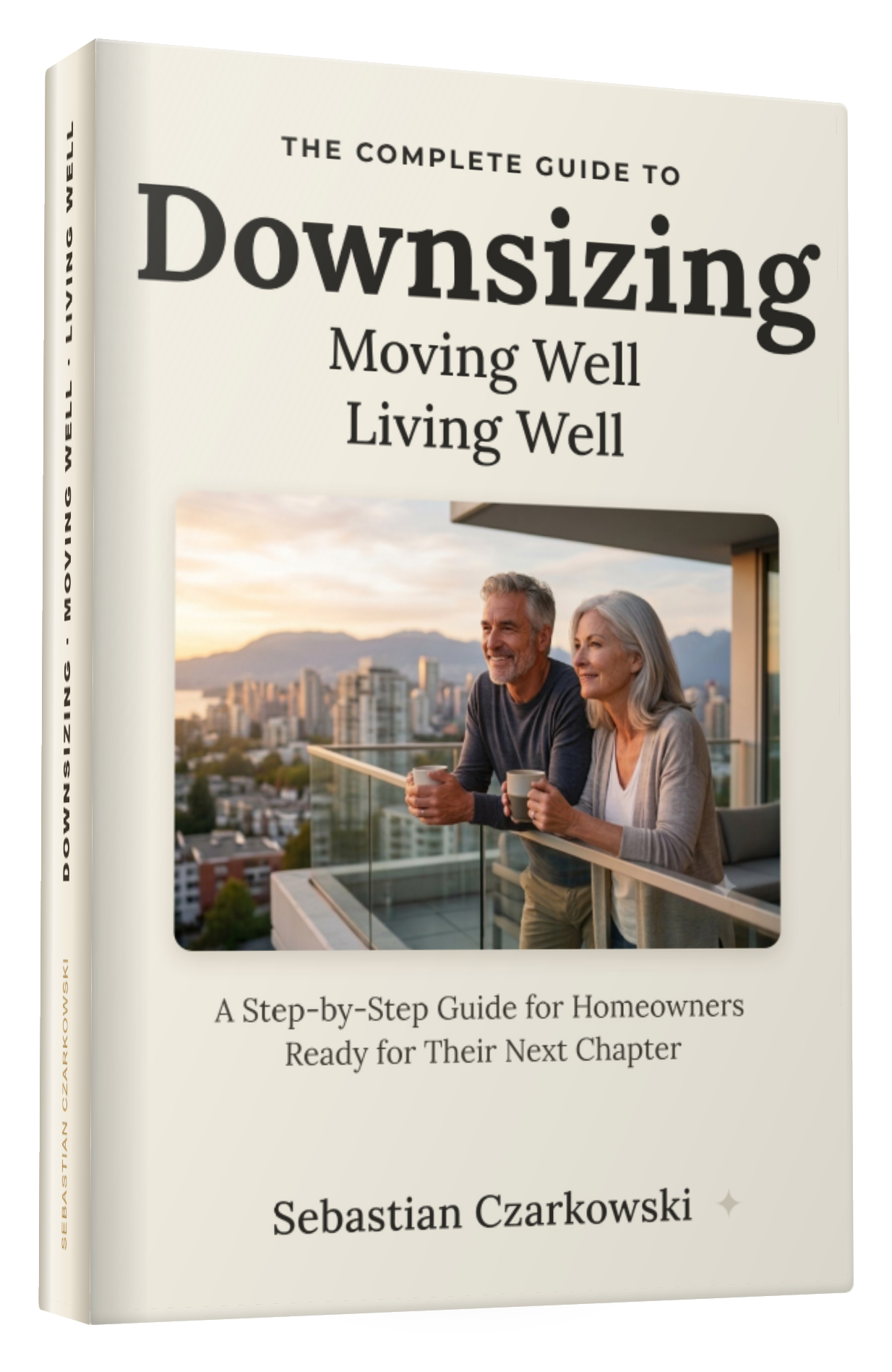
The Complete Guide to Downsizing, Moving & Living Well is my 145-page guide for Canadian homeowners doing exactly what this page describes — deciding when to move, what to do with a lifetime of belongings, and how to turn the family home into the next chapter. It's on Amazon, and you can read the whole thing free as a digital copy.
Get the free digital copy → 145 pages · a $38 value on Amazon, yours freeSelling first is the lower-risk path for most downsizers, and it is the one I recommend in the majority of cases. The moment your sale is firm, you know your exact budget — your real net proceeds, not an estimate — and you can shop for your next home as a strong, financing-ready buyer with no subject-to-sale condition holding you back. In a competitive situation for a scarce rancher or 55+ unit, that certainty is a genuine advantage.
The trade-off is the possible gap between selling and finding the right next home. We manage this two ways. First, by negotiating a longer or flexible completion and possession date on your sale — sixty, ninety, even a hundred-and-twenty days is often achievable — which gives you a runway to buy. Second, if a gap still opens, a short rental or a stay with family bridges it, and your equity sits safely earning interest in the meantime. For a downsizer who values certainty and a calm budget, selling first is usually the most comfortable route.
Buying first makes sense when the right home is genuinely hard to find and you cannot risk missing it — a specific single-level rancher, a particular age-restricted building with rare turnover, or a unit near family. If you find the one, securing it first removes the anxiety of selling and then scrambling to find somewhere to land. It also means you move once, on your schedule, rather than potentially twice.
The risk is financial: until your current home sells, you may own two properties and carry two sets of costs. This is where bridge financing comes in — a short-term loan, secured against your existing home's equity, that funds the new purchase until your sale completes. Lenders generally want to see a firm (sold) sale before extending a bridge, which is why buying first works best when your current home is highly sellable and you have the financial cushion to absorb a short overlap. I'll be candid with you about whether your situation suits this path.
Often, yes — and it is the ideal outcome when it can be arranged. By negotiating the completion and possession dates on both transactions, we can aim to have your sale and your purchase close within a day or two of each other, so the proceeds from selling fund the purchase directly and you move once. This avoids both bridge financing and any rental gap. It takes coordination — two sets of lawyers, two sets of dates, and a little flexibility from both other parties — but it is done all the time.
The catch is that perfectly simultaneous closings remove your slack: if one side is delayed, the other is affected. That is why I usually build in a small buffer and have a fallback ready (a short bridge or a flexible possession). The structure we choose comes down to a frank conversation about your finances, your risk comfort, and how rare your target next home is. There is a right answer for you specifically, and finding it is part of my job.
| Approach | Best for | Main risk | How we manage it |
|---|---|---|---|
| Sell first | Most downsizers; those who want budget certainty | Gap before finding the next home | Long/flexible completion date; short rental or family stay if needed |
| Buy first | When the ideal home is rare and can't be missed | Carrying two homes at once | Bridge financing (needs a firm sale); financial cushion |
| Close together | When dates can be coordinated | A delay on one side affects the other | Built-in buffer; bridge or flexible possession as fallback |
It starts with real numbers. I give you a grounded valuation of your current home so we know your likely net proceeds, and we look honestly at your cash position and comfort with risk. From there the choice between selling first, buying first, or closing together becomes clear rather than scary. I then coordinate the moving parts — pricing and listing your home to sell, watching the market for your landing spot, and negotiating completion dates on both sides to fit the plan.
Because I work owner-operated across the Tri-Cities, I am the one managing both ends of your move, not handing it off. If bridge financing is the right call, I'll point you to mortgage professionals who arrange it routinely; if a flexible possession is the answer, I'll negotiate for it. The whole aim is that you are never genuinely stuck with two homes or none — just guided, step by step, from one to the next.
Is it safer to sell first or buy first when downsizing?
For most downsizers, selling first is the lower-risk choice: you know your exact budget and avoid carrying two homes. Buying first is safer only when the ideal next home is rare and you have the financial cushion (and usually a firm sale) to support bridge financing. The best choice depends on your finances and risk comfort.
What is bridge financing and will I qualify?
Bridge financing is a short-term loan secured against your current home's equity that funds your new purchase until your sale completes. Lenders typically require a firm (sold, subject-free) sale on your existing home before approving it. It works best when your current home is highly sellable and you can absorb a brief overlap in costs.
Can my sale and purchase close on the same day?
Often yes. By negotiating completion and possession dates on both transactions, we can aim to close them within a day or two so the sale proceeds fund the purchase and you move once — avoiding both bridge financing and a rental gap. We usually build in a small buffer in case one side is delayed.
What if I sell and can't find the right place in time?
We plan for it. A longer or flexible completion date on your sale (often 60–120 days) gives you a runway to buy. If a gap still opens, a short-term rental or a stay with family bridges it while your equity sits safely earning interest. You're never forced to buy the wrong home under deadline pressure.
Won't I have to move twice if I sell first?
Not necessarily. With a flexible possession date or by closing the two transactions close together, many downsizers move only once. Even when a short interim stay is needed, careful date negotiation usually keeps it brief. The goal is always to minimize disruption.
How do I decide which approach is right for me?
Start with a real valuation of your current home so you know your likely net proceeds, then weigh your cash position and how much uncertainty you're comfortable with against how rare your target next home is. I'll walk through all three structures with you and recommend the one that fits — there's a right answer for your specific situation.
Knowing your real net proceeds is what makes the sell-first-or-buy-first decision easy instead of stressful. I'll give you an honest, no-pressure valuation to build the plan around.
What's My Home Worth → Or call Sebastian directly: (604) 788-4355The full, unhurried plan for downsizing in the Tri-Cities — valuation, where to go, timing, and belongings.
Back to the downsizing guideA directory of age-restricted 55+ strata buildings across the Tri-Cities, with units currently for sale.
Find where to landModel your next home's financing, including a smaller mortgage or an all-cash purchase from your equity.
Run the numbers
This page is general information, not legal, tax, or financial advice, and market figures are live or current as of July 2026 and subject to change. Every home and sale is different — confirm specifics with a qualified real estate lawyer or accountant where relevant. Sebastian Czarkowski is a licensed REALTOR® (BCFSA) with Royal LePage Elite West.